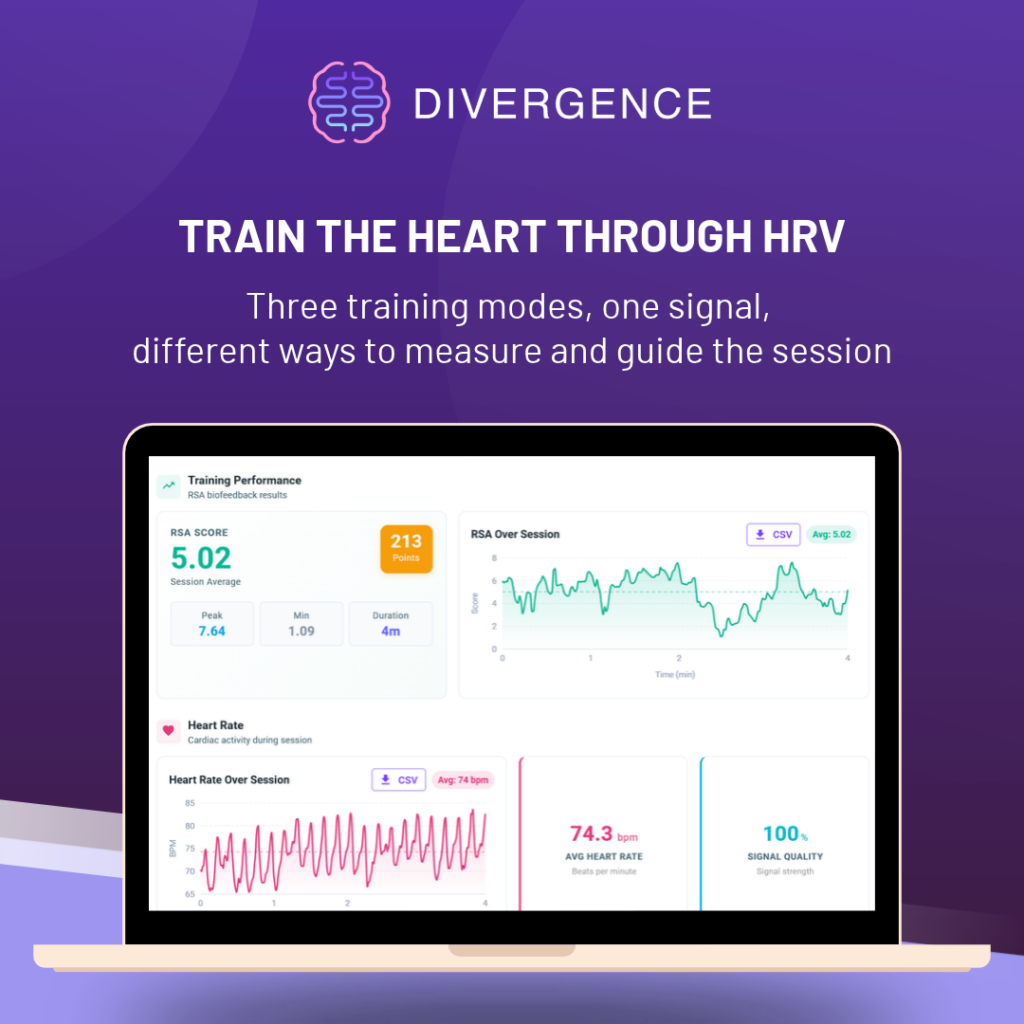
Training using the heart beat patterns has become increasingly popular in recent years. There is a great deal of research that backs the efficacy of such training in a variety of wellness scenarios. In this blog article, I’ll review the various methods / modes for training using heart rate variability (HRV) on the Divergence Platform.
Before we dive into each of the modes, it is important to understand what HRV is and what it isn’t. HRV isn’t noise. It’s the signature of a nervous system continuously adjusting itself. For example, when someone breathes slowly and evenly, that adjustment falls into a smooth, rolling wave.
Every HRV mode listens to the same thing – the small changes in timing between one beat and the next. RSA, LF, and Coherence are three different ways of scoring that signal, and each one is the right answer to a different question.
| RSA | LF | Coherence | |
|---|---|---|---|
| IN A PHRASE | Is the rhythm wave-like right now? | How much variability sits in the regulation band? | Is the rhythm locked into one clean wave? |
| CHARACTER | Fastest, most forgiving | Measured, trend-friendly | Most demanding, best evidenced |
| TIME TO FIRST SCORE | ~10 seconds | ~1 minute | ~1 minute |
| FIRST IMPRESSION | ●●● | ●●○ | ●○○ |
| CARRIES ACROSS SESSIONS | ●○○ | ●●● | ●●○ |
| RESEARCH DEPTH | ●●○ | ●●● | ●●● |
The one-line version. Pick RSA to get someone breathing well in their first two minutes. Pick LF when the user wants numbers that still mean something next week. Pick Coherence when the goal is the real skill, backed by the deepest literature.
What all three share
When looking at HRV training in the context of the Divergence Platform, it is important to note that all three HRV modes share the same underlying infrastructure.
Same hardware
An ECG chest signal or an optical BVP sensor. No extra kit to switch modes.
Same beat detection
All three are built from the same cleaned beat-to-beat stream, so the underlying session data is identical.
Same quality gate
Contact quality is tracked continuously. A loose electrode doesn’t quietly become a bad score.
Same cadence
Feedback updates about 2.5 times a second in every mode. What differs is how far back each one looks.
Same scoring economy
A perfect run banks up to 100 points a minute in all three, so streaks stay comparable.
Same session record
Peak reached and full-session average are logged, not just the last number on screen.
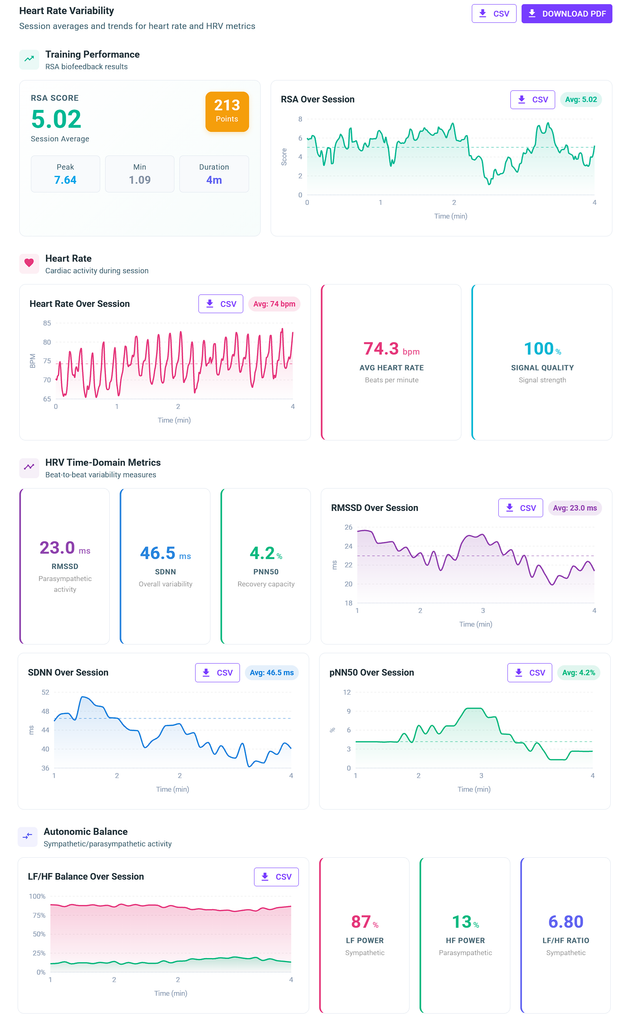
Every HRV session done on the platform comes with the full standard HRV panel – RMSSD, SDNN, LF, HF, normalized units and average heart rate. Users never have to choose between the mode they enjoy and the mode that gives them data.
RSA – the responsive one

What it is. Respiratory Sinus Arrhythmia (RSA) is the formal name for something completely ordinary: your heart speeds up a little when you inhale and slows down a little when you exhale. It’s the most immediate link between breath and heart, and the first thing that shows up when someone starts more controlled breathing.
What we measure. RSA mode asks a simple question a few times a second – is this heart rhythm behaving like a smooth wave? It fits an oscillation to the last few seconds of the rhythm and scores how cleanly the real signal matches it. Strong, smooth swings score high; flat, erratic or jittery rhythms score low.
Why it’s the most responsive. It needs only about ten seconds of rhythm to produce a meaningful score, where the other two need a full minute. That’s the whole difference in one sentence. A user takes two slow breaths, and the score climbs; they get distracted, and it drops. The loop between what you do and what you see is short enough that people learn from it without being told what to do.
| WINDOW 10 seconds | FEELS LIKE Immediate, encouraging | ROLE The hook |
Where it’s the right call
- The very first session anyone ever runs.
- Kids, teens, and anyone whose attention won’t survive a one-minute lag before the screen responds.
- Short sessions – a five-minute reset between meetings, a pre-performance anchoring.
- Anyone who tried biofeedback before, found it unresponsive, and quit.
The tradeoff
RSA is a right-now quality score, not a standardized clinical index. It’s excellent at telling you whether this moment is going well, and comparatively weak at telling you whether this month is going better than last. It’s the mode that teaches the skill the fastest; it isn’t the one you build a long term trend on.
LF – the measurable one

What it is. Breaks the heart rhythm into the speeds it oscillates at and distinct bands appear. The low-frequency (LF) band – roughly one cycle every 7 to 25 seconds – is where the body’s blood-pressure regulation loop lives. It’s also, conveniently, right where slow breathing puts you. LF mode reports how much of your total variability is sitting in that band, as a straightforward percentage.
Why the percentage matters. Raw variability differs enormously between people and between the same person on different days, for reasons unrelated to skill: age, hydration, caffeine, sleep, and how recently they climbed the stairs. Reporting LF as a share of the total strips a good deal of that out. It turns the number into something that can honestly be compared to yesterday’s – the difference between my rhythm was bigger today, and my rhythm was better organized today.
The metrics that come with it. This is the mode to lead with when someone wants to track changes over time. LF sits inside the standard HRV panel that clinicians and researchers already know – the same RMSSD, SDNN, pNN50 and frequency-band measures that appear in the literature and in clinical reports. Users who track their own health data recognize these names, and that recognition is a genuine asset rather than a manufactured one: these aren’t proprietary scores we invented; they’re the field’s shared vocabulary.
| WINDOW 60 seconds | FEELS LIKE A tide, not a ripple | ROLE The retainer |
Where it’s the right call
- Users who already track sleep, recovery, or HRV elsewhere and want this to fit alongside it.
- Sessions of ten minutes or more, where the one-minute window costs nothing.
- Clinical and research settings, where the metric needs a name that appears in the literature.
- Anyone building a habit and wanting week-over-week evidence that it’s working.
- Progress reviews and coach check-ins – any conversation about trends rather than moments.
The tradeoff
It needs a clean minute before it means anything. For the first sixty seconds, the user is essentially flying blind, and a newcomer may read that quiet start as the product not working. LF suits people who already know roughly what they’re doing – or who’ve been told what to expect.
Coherence – the sophisticated one

What it is. Coherence asks the hardest version of the question. Not: is there a wave, and not is the wave in the right band, but: is the entire heart rhythm collapsing into one single, clean, dominant oscillation?
What we measure. The system finds the strongest rhythm in your heart rate – anywhere between about three and fifteen cycles a minute – then measures how much of your total variability that one rhythm accounts for versus everything else combined. A high score means one frequency is dominating and the rest has gone quiet. Visually it’s unmistakable: the messy scribble of an ordinary heart rhythm resolves into something close to a drawn sine wave.
Why this is the deep one. That state has a name – resonance – and it’s the most studied phenomenon in the field. Everyone has a breathing rate, usually near six breaths a minute, at which heart rhythm, blood pressure rhythm, and breathing fall into phase and reinforce each other. It’s the closest thing biofeedback has to a physical sweet spot, and hitting it deliberately is a trainable skill with two decades of peer-reviewed work behind it. When an evidence-led buyer asks what our science is, coherence is the answer with the most supporting literature.
What it feels like. The hardest to move, and the most satisfying when it does. Coherence doesn’t reward trying; it rewards finding the right rate and holding it. That gives it a genuine skill ceiling, which is what makes people stay with it – users describe the moment it locks in as feeling qualitatively different from just breathing slowly, because it is.
| WINDOW 60 seconds | FEELS LIKE A skill, not a setting | ROLE The mastery |
Where it’s the right call
- The flagship protocol. If we describe one mode as the training, this is it.
- Resonance-frequency work: finding a user’s personal best breathing rate and training at it.
- Clinical and evidence-led conversations.
- Returning users who have outgrown the easy win and want something with depth.
- Anyone whose stated goal is the underlying capacity rather than in-the-moment calm.
The tradeoff
It’s the slowest to respond and the least forgiving of a rough start. A first-timer can easily spend five minutes at a low score without understanding why. Coherence is the mode people should graduate into, not the one they should meet first.
Choosing by situation
| If the user is… | Start them on | Because |
|---|---|---|
| Trying biofeedback for the first time | RSA | It responds inside their first two breaths |
| A child or teen | RSA | The feedback loop is short enough to hold attention |
| Taking a five-minute reset | RSA | The other modes spend a minute warming up |
| Already tracking HRV elsewhere | LF | Speaks the vocabulary they’ve already learned |
| Building a daily habit | LF | Produces a number worth charting week to week |
| A clinician or researcher | LF → Coherence | Standard panel first, then the trainable target |
| A returning user who’s plateaued | Coherence | Has the skill ceiling the others lack |
| Chasing the actual physiology | Coherence | Resonance is the real target, and the best evidenced |
| Doing serious resonance work | Coherence | The only mode that directly scores it |
A pattern worth designing onboarding around. RSA to hook, LF to retain, Coherence to master. Most users should meet all three, in that order, over their first few weeks – and none of it costs them any data, because the full set of HRV metrics is recorded either way.
Can a session run more than one mode?
Yes. Modes can be combined within a protocol, and points accumulate per mode type, so a session that trains two things keeps two honest scores rather than blurring them into one. The common pairing is a responsive mode for moment-to-moment guidance alongside a slower one for the session verdict – the user gets both the ripple and the tide.
Want to know more?
Are you interested in learning more about how HRV training works on the Divergence Platform or how you could incorporate it into your existing clinical / performance coaching workflows? Reach out to us today using the form below and someone will be in touch to schedule a call.