Neurofeedback for Sleep
EEG neurofeedback has 40+ years of peer-reviewed research as a non-pharmacological tool for insomnia and sleep quality – centred on training the same sensorimotor rhythm and sleep spindles your brain uses to fall and stay asleep.
40+ years
of EEG NF sleep research, since Hauri 1981
SMR & spindles
the canonical sleep EEG biomarkers
ISNR-listed
in the comprehensive NF bibliography
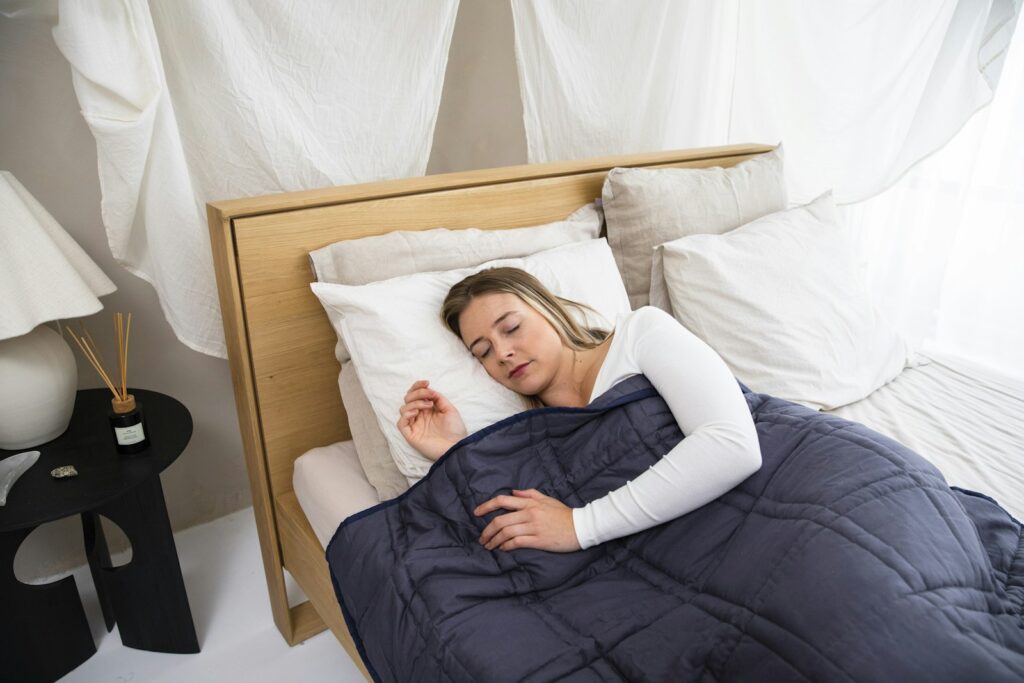
Sleep was one of the very first targets of EEG biofeedback research. Peter Hauri and colleagues published their landmark insomnia trials in the early 1980s, demonstrating that training sensorimotor rhythm (SMR) – the same EEG signature the brain produces just before falling asleep – meaningfully reduces sleep onset latency and improves sleep continuity. Modern groups (Hoedlmoser, Schabus, Cortoos, Arns) have refined the protocols across decades, and recent systematic reviews continue to confirm the basic finding: structured EEG neurofeedback measurably improves both subjective and objective sleep.
What the Research Shows
EEG neurofeedback consistently improves sleep onset, sleep quality, and total sleep time in patients with insomnia, with a 40-year research record across multiple independent groups. The strongest evidence is for sensorimotor rhythm (SMR) and sleep-spindle (sigma) protocols, which directly train the brain rhythms that initiate and maintain sleep. Modern controlled trials confirm gains on both polysomnography (objective sleep measures) and patient-rated sleep quality – and the effects often persist long after training ends.
How EEG Neurofeedback Addresses Sleep
Falling asleep is, at the EEG level, a transition into sensorimotor rhythm (12-15 Hz) over the central cortex, followed by sleep spindles (12-16 Hz) over central and frontal regions. People with insomnia often struggle to generate or sustain these rhythms – their brains stay in the more aroused beta range when they should be slipping into sleep. EEG neurofeedback measures these patterns in real time and rewards the brain when it shifts toward the sleep-onset profile. Across multiple sessions, the brain learns to find and hold those states more easily on its own. The most studied sleep protocols are SMR enhancement (Hauri, Hoedlmoser), sigma/sleep-spindle training (Berner, Schabus), and individualized Z-score SMR (Hammer).
Foundational Research
The sleep neurofeedback canon – cited extensively in the ISNR Comprehensive Bibliography – establishes the basic finding across multiple research groups and decades.
Hauri, 1981 – first controlled trial of EEG biofeedback for insomnia
Archives of General Psychiatry, 38(7): 752-758.
The seminal study that put EEG neurofeedback for sleep on the map. Insomnia patients receiving SMR/theta biofeedback showed significant reductions in sleep onset latency and improvements in sleep quality versus controls. Established the basic mechanism that subsequent decades of research have refined.
Bell, 1979 – theta biofeedback for sleep-onset insomnia
Biofeedback & Self-Regulation, 4(3): 229-236.
Early case study using theta biofeedback to treat sleep-onset insomnia. Documented significant reductions in sleep latency and supported the feasibility of EEG self-regulation as a non-pharmacological insomnia treatment. A foundational ISNR-bibliography entry.
Hauri, Percy, Hellekson, Hartmann & Russ, 1982 – replication of EEG NF for psychophysiologic insomnia
Biofeedback & Self-Regulation, 7(2): 223-235.
Replication study confirming the original Hauri 1981 findings. Patients receiving SMR or theta neurofeedback showed sustained improvements in sleep onset and continuity. Established replicability of the foundational sleep neurofeedback effect.
Berner, Schabus, Wienerroither & Klimesch, 2006 – sigma NF improves sleep spindles and memory
Applied Psychophysiology & Biofeedback, 31(2): 97-114.
Healthy adults trained in sigma-band (12-15 Hz) neurofeedback showed significant increases in sleep-spindle density and parallel improvements in declarative memory consolidation – direct evidence that EEG neurofeedback can shape the brain rhythms that drive both sleep and learning. DOI: 10.1007/s10484-006-9013-7 | PMID 16838503
Hoedlmoser et al., 2008 – SMR neurofeedback improves sleep and learning
Sleep, 31(10): 1401-1408.
Healthy adults completed SMR (12-15 Hz) neurofeedback over 10 sessions. Post-training, they fell asleep faster and showed enhanced sleep-spindle activity, with parallel improvements in declarative memory consolidation. The cleanest mechanistic study linking SMR neurofeedback to objective sleep measures. DOI: 10.5665/sleep/31.10.1401 | PMID 18853938
Cortoos et al., 2010 – tele-neurofeedback for primary insomnia
Applied Psychophysiology & Biofeedback, 35(2): 125-134.
Patients with primary insomnia completed remote (home-based) EEG neurofeedback. The intervention produced significant improvements in sleep latency and total sleep time on both subjective ratings and objective measures, supporting feasibility and effectiveness of tele-delivered sleep NF. DOI: 10.1007/s10484-009-9116-z | PMID 19826944
Hammer, Colbert, Brown & Ilioi, 2011 – Z-score SMR NF for insomnia (pilot)
Applied Psychophysiology and Biofeedback, 36(4): 251-264.
12 insomnia patients completed individualized Z-score SMR neurofeedback. Significant improvements on the Insomnia Severity Index, the Pittsburgh Sleep Quality Index, and sleep onset latency, all sustained at follow-up. Demonstrated that individualized Z-score protocols translate the foundational SMR finding into modern clinical practice. DOI: 10.1007/s10484-011-9165-y | PMID 21789650
Recent Randomized Trials and Meta-Analyses
Modern controlled trials and reviews continue to support and extend the foundational findings.
Schabus et al., 2014 – SMR conditioning enhances sleep quality and memory in insomnia
Biological Psychology, 95: 126-134.
Sham-controlled trial of instrumental SMR conditioning in primary insomnia. The active arm produced significant improvements in subjective sleep quality, sleep-onset latency, and overnight memory consolidation. A rigorous modern replication of the foundational Hauri findings. DOI: 10.1016/j.biopsycho.2013.02.020 | PMID 23507471
Arns et al., 2014 – theta/beta and SMR NF reduce sleep-onset latency
Frontiers in Human Neuroscience, 8: 1019.
Trial of EEG neurofeedback in ADHD patients with comorbid sleep-onset problems. Both theta/beta and SMR protocols significantly reduced sleep-onset latency, with SMR showing the larger effect. Adds modern, mechanism-clear evidence for SMR-driven sleep improvement. DOI: 10.3389/fnhum.2014.01019 | PMID 25566034
Lambert-Beaudet et al., 2021 – systematic review of EEG NF for insomnia
Sleep Medicine Reviews, 60: 101541.
Systematic review of EEG neurofeedback trials in insomnia and sleep quality. Concludes that NF produces meaningful improvements in subjective sleep, with SMR and sigma protocols showing the most consistent effects. The current canonical review of sleep NF evidence. DOI: 10.1016/j.smrv.2021.101541 | PMID 34534854
Why Neurofeedback Often Appeals to People with Sleep Problems
- Non-pharmacological. No sleeping pills, no rebound insomnia, no daily dosing.
- Skill-based and durable. The brain learns to fall asleep more easily – and follow-up studies show the gains often persist long after training ends.
- Excellent tolerability. Decades of safety data; the vast majority of trials report no serious adverse events.
- Compatible with everything else. Pairs naturally with CBT-I, sleep hygiene, and lifestyle change rather than competing with them.
- Works on real biomarkers. SMR and sleep spindles are the EEG signatures the brain itself uses to initiate and maintain sleep.
- Backed by ISNR. The International Society for Neuroregulation & Research catalogues the supporting research and standards of practice.
A Few Honest Caveats
- Sleep apnea, restless legs, and other primary sleep disorders need targeted medical treatment alongside or before neurofeedback.
- Standard protocols typically need 15-25 sessions for full benefit.
- Sleep is multifactorial: NF works best as part of a broader plan including consistent schedule, light exposure, and stimulant timing.
- Severe chronic insomnia often benefits from combining neurofeedback with cognitive behavioural therapy for insomnia (CBT-I).
Is Neurofeedback Right for Your Sleep?
If sleep hygiene, CBT-I, and lifestyle changes are not getting you to consistent, restorative sleep – and you would prefer a non-pharmacological, skill-based approach – EEG neurofeedback has one of the longest research track records of any complementary intervention for insomnia. Most patients see meaningful change within 15-25 sessions, and many report that the gains persist long after training ends.
Want to Dig Deeper Into the Research?
The International Society for Neuroregulation & Research (ISNR) maintains the comprehensive bibliography of peer-reviewed neurofeedback studies across conditions.
Last reviewed: April 2026. This page is for general information and does not constitute medical advice. Always speak with a qualified clinician about your treatment options.