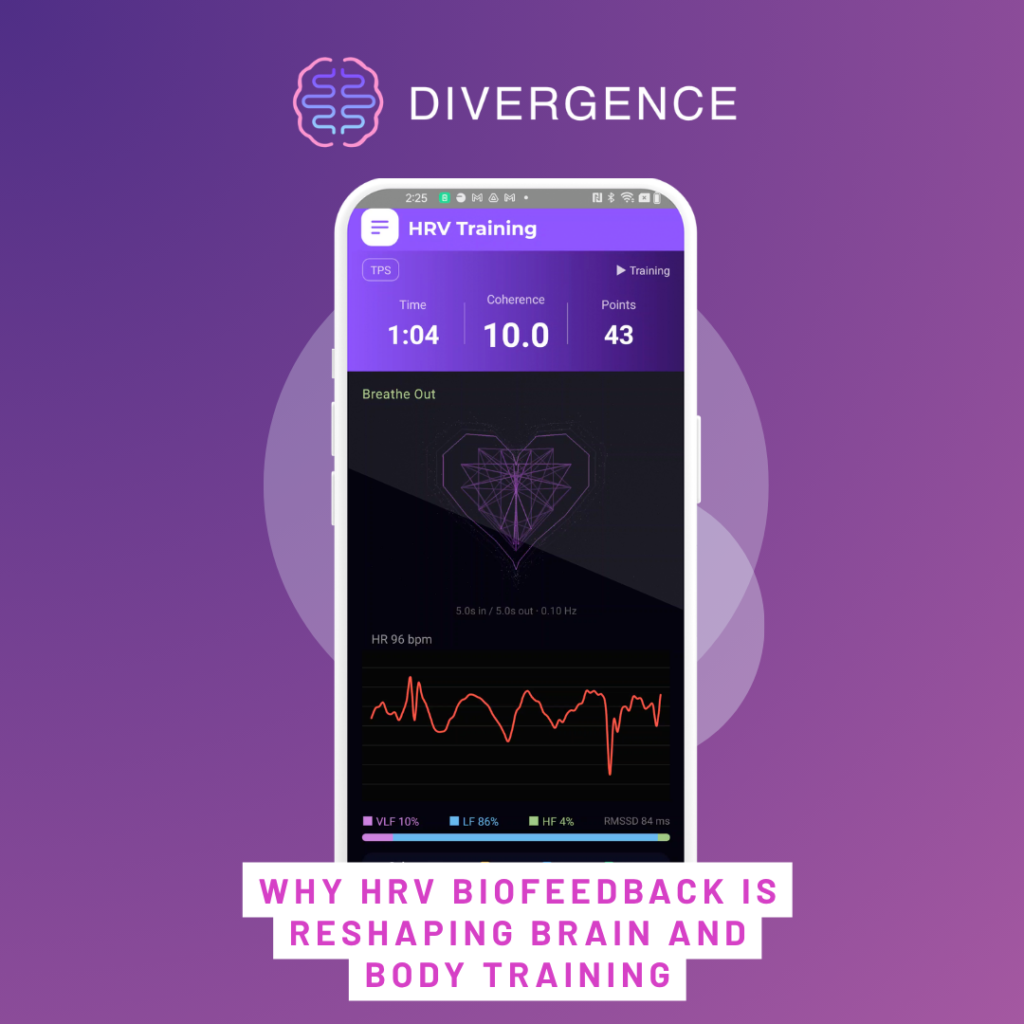
Most clinicians can already see when a client is showing signs of dysregulation. They watch the breath go shallow, the shoulders hunch, the eyes flatten. The harder problem is showing the client what you see, and then giving them a way to change these reactions in real time. That is the gap heart rate variability biofeedback (HRVB) is built to close, and over two decades of randomized controlled trials it has emerged as one of the most evidence-backed self-regulation tools in the field (Lehrer et al., 2020).
This article walks through what HRV actually measures, why training it changes outcomes across anxiety, sleep, focus, and recovery, and how a properly designed HRV training suite fits alongside the EEG work many practices are already doing.
What HRV Is, in One Paragraph
Heart rate variability is the millisecond-level fluctuation between consecutive heartbeats. A healthy nervous system does not tick like a metronome (Shaffer & Ginsberg, 2017). It speeds up slightly on the inhale and slows down on the exhale, and it constantly adjusts to internal and external demands. That variability is a direct readout of how flexibly your autonomic nervous system, and specifically the vagus nerve, can move between activation and recovery. According to the neurovisceral integration model, higher vagally mediated HRV reflects better functioning of prefrontal-subcortical inhibitory circuits, and is consistently associated with stronger emotional regulation, attentional control, and adaptive capacity under stress (Thayer et al., 2009; Thayer et al., 2012). Flat, rigid heart rhythms reflect the opposite.
“If EEG tells you what the brain is doing, HRV tells you what the body is allowing it to do.”
Why Training HRV Actually Works
HRV training works because slow, paced breathing in the 4.5 to 7 breaths per minute range engages the baroreflex on every cycle and drives the heart rate signal into a high-amplitude oscillation (Lehrer & Gevirtz, 2014). That state, often called coherence, is measurable in real time as a concentration of HRV power in the low-frequency band. The result is a directly trainable signal: the client breathes, the coherence score climbs, and the autonomic nervous system gets a repeated workout in flexible activation and recovery. Done consistently, this produces durable changes in autonomic tone (Lehrer et al., 2020).
The downstream effects are well documented across two decades of peer-reviewed work:
- Reduced anxiety and stress symptoms. A meta-analysis of 24 randomized and controlled studies (484 participants) found a large pre-post within-group effect size for HRVB on self-reported stress and anxiety (Hedges’ g = 0.81), with a comparable between-group effect against control conditions (g = 0.83) (Goessl et al., 2017).
- Improved depressive symptoms. A meta-analysis of 14 RCTs (794 adult participants) reported a medium effect size for HRVB on depressive symptoms (g = 0.38, 95% CI [0.16, 0.60]) (Pizzoli et al., 2021).
- Better emotional regulation and vagal tone, consistent with the neurovisceral integration model linking higher resting HRV to stronger prefrontal inhibitory control and reduced reactivity (Thayer et al., 2009).
- Enhanced cognitive performance, including measurable improvements in attention, working memory, and executive function under load (Hansen et al., 2003; Thayer et al., 2009).
- Improved athletic and performance outcomes, with a systematic review of HRVB in athletes reporting performance enhancement in the majority of studies reviewed (Jiménez Morgan & Molina Mora, 2017).
- Broad symptomatic and functional benefit, with the most comprehensive meta-analysis to date (58 RCTs from 1,868 screened papers) reporting a significant small-to-moderate effect favoring HRVB across anxiety, depression, anger, athletic and artistic performance, PTSD, sleep, and quality of life, with effects not different from other established treatments (Lehrer et al., 2020).
Crucially, HRVB is one of the few self-regulation modalities where the client gets a clean, real-time visual of whether what they are doing is working. That immediate feedback loop is what turns breathing exercises into a trainable skill rather than a vague suggestion.
Why Tracking HRV Matters as Much as Training It
Even when HRV is not the primary intervention, tracking it changes how a practice operates. HRV is a sensitive, validated index of autonomic flexibility, cumulative load, and recovery, and short-term resting measurements have been shown to track meaningful changes in physical and psychological state (Shaffer & Ginsberg, 2017). A morning HRV reading reflects sleep quality, hydration, cumulative stress load, illness onset, alcohol intake, and recovery from training, all in a single number that is sensitive to change within days.
For a clinician, that means three things:
- Objective progress data. Subjective questionnaires miss what the autonomic nervous system shows clearly. HRV trends across weeks make it possible to demonstrate, not just describe, that a client is improving.
- Earlier intervention signals. A sudden drop in resting HRV often precedes a flare-up, a relapse, or a missed session. Catching that drift early lets you adjust the protocol before the client loses momentum.
- Stronger client adherence. When clients can see their own data improving, compliance climbs. The metric becomes the motivation.
Where HRV and EEG Meet
For practices already running neurofeedback, HRV is not a competing modality. It is the missing half of the picture. EEG captures cortical state. HRV captures autonomic state. The two systems are coupled through the central autonomic network and converging prefrontal-subcortical circuits (Thayer et al., 2012), but they are not the same, and clients often need work on both. A client who cannot quiet their sympathetic drive will struggle to produce the EEG signatures you are training toward, no matter how well-designed the protocol. Building autonomic flexibility first, or in parallel, makes the brain training itself more productive.
This is why we are building HRV biofeedback directly into the Divergence platform rather than treating it as a separate product. Practitioners should not have to juggle three apps and two sensors to do integrated work.
What is Coming to the Divergence Platform
Our upcoming HRV biofeedback training suite is designed to give clinicians a clinical-grade tool that is also actually pleasant for clients to use. A few of the principles behind it:
- Classical HRV Coherence as the core metric. We compute coherence using the well-established frequency-domain method, the same approach used across the HRVB literature (Lehrer & Gevirtz, 2014; Shaffer & Ginsberg, 2017). It is highly sensitive to autonomic nervous system shifts in the majority of the population, which means most clients see their score respond meaningfully within the first session. Clinicians can adjust breathing pacing per protocol, without forcing every client through a separate resonance frequency identification step.
- Proprietary signal processing for real-world conditions. Clinical HRV is only as good as the underlying ECG. We have developed and tested proprietary algorithms that reduce the effects of ambulatory noise from client movement, intermittent poor electrode contact, and ambient environmental interference. The result is a cleaner ECG trace, fewer artifact-driven false readings, and more accurate HRV computation in the real conditions clinicians and clients actually work in, not just in a quiet lab.
- Multiple device integration out of the box. Polar H10 chest strap, Polar Loop, TPS, Synchroni Pento, and Synchroni Trio are supported natively, so clients can use high-quality, research-grade hardware they already trust and own.
- Audio and visual feedback designed for engagement. Coherence is conveyed through evolving soundscapes and clean visuals, not flashing dashboards. Sessions feel restorative, which is what brings clients back.
- Built into the same platform as EEG. Sessions, compliance data, and progress trends live alongside neurofeedback work in a single client record.
- Practitioner-controlled protocols. You decide session length, feedback style, and progression. The platform handles the signal processing.
Who This is For
If you are a neurofeedback clinician, an integrative health practitioner, a performance coach, a therapist working with anxiety or trauma, or a clinic running structured wellness programs, HRV biofeedback should be in your toolkit. It is one of the few interventions that is broadly indicated, durable, low-risk, and inexpensive to deliver once the infrastructure is in place. The evidence base supports it as an effective complementary intervention across health, medical, educational, and sport applications (Lehrer et al., 2020).
Get Early Access
The HRV biofeedback suite is entering pilot release with a small group of partner clinics. If you would like to be considered for early access, see a live demo, or discuss how it would fit into your existing programs, reach out to our team. We are particularly interested in talking with practices that already use EEG and want to formalize an autonomic component.
References
Goessl, V. C., Curtiss, J. E., & Hofmann, S. G. (2017). The effect of heart rate variability biofeedback training on stress and anxiety: A meta-analysis. Psychological Medicine, 47(15), 2578–2586. https://doi.org/10.1017/S0033291717001003
Hansen, A. L., Johnsen, B. H., & Thayer, J. F. (2003). Vagal influence on working memory and attention. International Journal of Psychophysiology, 48(3), 263–274. https://doi.org/10.1016/S0167-8760(03)00073-4
Jiménez Morgan, S., & Molina Mora, J. A. (2017). Effect of heart rate variability biofeedback on sport performance, a systematic review. Applied Psychophysiology and Biofeedback, 42(3), 235–245. https://doi.org/10.1007/s10484-017-9364-2
Lehrer, P. M., & Gevirtz, R. (2014). Heart rate variability biofeedback: How and why does it work? Frontiers in Psychology, 5, 756. https://doi.org/10.3389/fpsyg.2014.00756
Lehrer, P., Kaur, K., Sharma, A., Shah, K., Huseby, R., Bhavsar, J., Sgobba, P., & Zhang, Y. (2020). Heart rate variability biofeedback improves emotional and physical health and performance: A systematic review and meta-analysis. Applied Psychophysiology and Biofeedback, 45(3), 109–129. https://doi.org/10.1007/s10484-020-09466-z
Pizzoli, S. F. M., Marzorati, C., Gatti, D., Monzani, D., Mazzocco, K., & Pravettoni, G. (2021). A meta-analysis on heart rate variability biofeedback and depressive symptoms. Scientific Reports, 11, 6650. https://doi.org/10.1038/s41598-021-86149-7
Shaffer, F., & Ginsberg, J. P. (2017). An overview of heart rate variability metrics and norms. Frontiers in Public Health, 5, 258. https://doi.org/10.3389/fpubh.2017.00258
Thayer, J. F., Hansen, A. L., Saus-Rose, E., & Johnsen, B. H. (2009). Heart rate variability, prefrontal neural function, and cognitive performance: The neurovisceral integration perspective on self-regulation, adaptation, and health. Annals of Behavioral Medicine, 37(2), 141–153. https://doi.org/10.1007/s12160-009-9101-z
Thayer, J. F., Åhs, F., Fredrikson, M., Sollers, J. J., III, & Wager, T. D. (2012). A meta-analysis of heart rate variability and neuroimaging studies: Implications for heart rate variability as a marker of stress and health. Neuroscience & Biobehavioral Reviews, 36(2), 747–756. https://doi.org/10.1016/j.neubiorev.2011.11.009