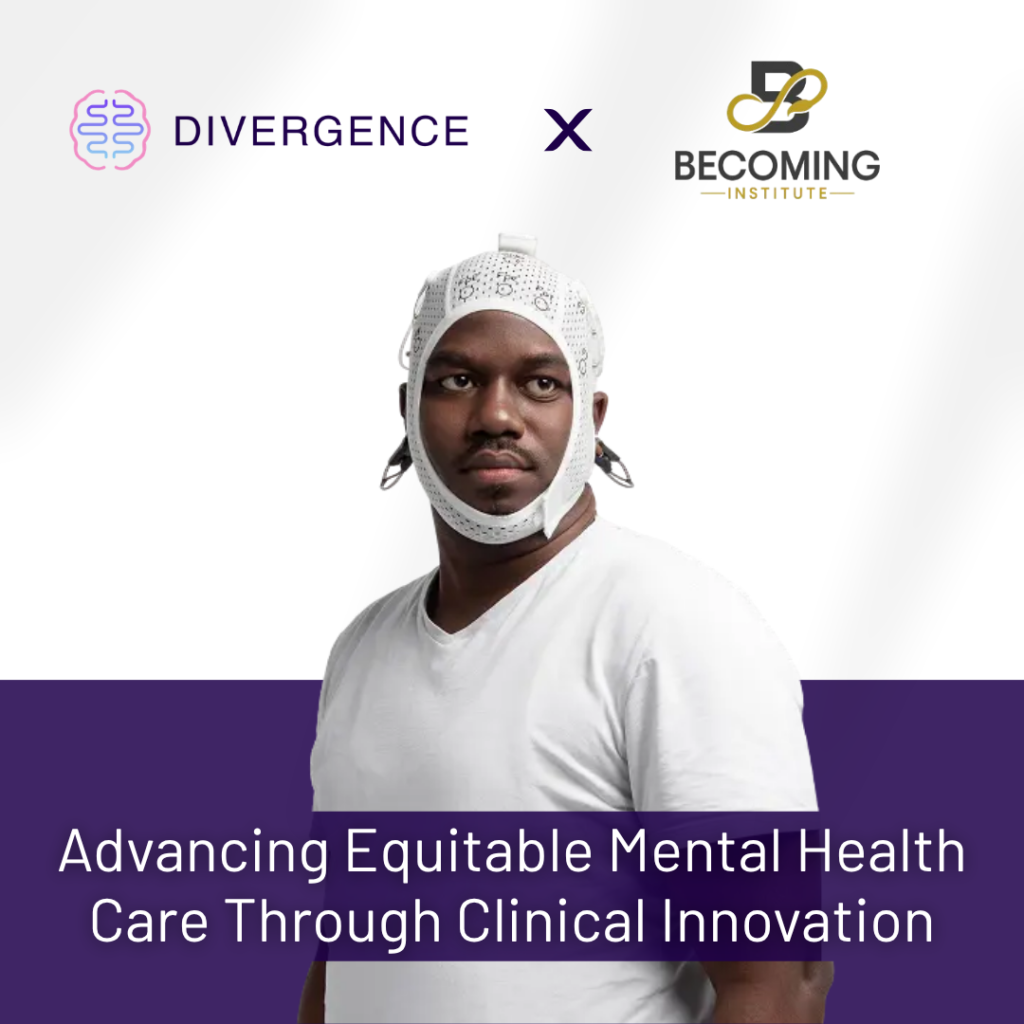
A Collaborative Insight from Divergence Neuro and Becoming Institute Inc.
July marks National Minority Mental Health Awareness Month: a vital observance that brings the ongoing need for equitable mental health care to the forefront of clinical and policy discussions. In this special feature, Divergence Neuro and Becoming Institute Inc. have partnered to explore how the intersection of neurotechnology and culturally responsive practice can redefine the healing journey for BIPOC communities.
For many Black, Indigenous, and People of Color (BIPOC) individuals, the search for care begins long before a first appointment. It begins in the private labour of deciding whether one’s story will be understood, whether one’s pain will be reduced to a symptom list, and whether healing can unfold without leaving culture, community, and dignity at the door. In that context, equitable care is not simply about access. It is about being met as a whole.
The World Health Organization (WHO) estimates that one in eight people globally lives with a mental disorder, yet the majority of individuals in low and middle-income countries receive no treatment (WHO, 2022). Even within higher-income systems like ours in Canada, disparities persist in diagnosis accuracy, access to culturally responsive care, and continuity of treatment. During National Minority Mental Health Awareness Month, we are reminded that BIPOC communities have always carried profound resilience alongside these inequities. The work before us is to ensure mental health systems recognize that resilience, honour lived experience, and support recovery in ways that are culturally safe, liberating, and clinically sound.
Cultural Responsiveness: The Bedrock of Clinical Safety
Cultural identity is not a peripheral variable; it is central to how individuals understand distress, communicate symptoms, and decide whether to remain in treatment. For clinicians, cultural responsiveness is the foundation of equitable mental health care. It is the prerequisite for clinical safety and the primary driver of patient retention in racialized populations.
Effective psychotherapy relies on more than intervention selection. It depends on the strength of the therapeutic alliance, which includes trust, agreement on goals, and collaboration in treatment planning. Meta-analytic evidence demonstrates that alliance quality consistently predicts positive outcomes across therapeutic modalities (Horvath et al., 2011). However, for many BIPOC clients, this alliance is built within a context of historical mistrust and systemic inequity.
Becoming Institute, moves beyond the “competency” model to a “posture” of cultural humility. This clinical posture requires us to acknowledge how systemic factors: discrimination, socioeconomic inequality, and intergenerational trauma: shape the nervous system and influence how a person comes to trust care again, reconnect with identity, and move toward wholeness.
Dr. Joan Samuels-Dennis, RN, Psychotherapist and Founder of the Becoming Institute, emphasizes this foundational principle: “Culturally responsive mental health care begins with understanding the person before the diagnosis. Without that foundation, clinical care risks missing the lived context that gives symptoms meaning and treatment direction.”
Neurofeedback and Biofeedback in Contemporary Clinical Practice
As we strive for equitable mental health care, neurofeedback and biofeedback are emerging as essential, clinician-guided approaches that provide real-time information about physiological processes associated with mental and emotional functioning. Neurofeedback typically uses electroencephalography-based signals to reflect brain activity patterns, while biofeedback may include heart rate variability, respiration, skin conductance, and muscle tension measurements.
These approaches are grounded in psychophysiological research demonstrating the relationship between autonomic nervous system regulation and emotional functioning (Thayer & Lane, 2000). Within clinical practice, they are used as adjunctive tools that provide additional insight into how clients respond to stress, relaxation, and regulation strategies over time. Rather than replacing psychotherapy or clinical judgment, these tools support clinicians by offering objective physiological data that complements self-report and clinical observation.
For individuals in the BIPOC community, this may be particularly relevant in cases where internal states are difficult to articulate or where physiological stress responses are not fully captured through story-telling alone. Rather than replacing psychotherapy or clinical judgment, these tools can support clinicians by offering objective physiological data that complements self report and clinical observation. This may be particularly relevant in cases where internal states are difficult to articulate or where physiological stress responses are not fully captured through conversation alone.
Alex Ni, Chief Executive Officer of Divergence Neuro, describes this integration: “Objective physiological data can provide clinicians with an additional layer of insight into how the nervous system responds to stress and regulation strategies. When combined with clinical expertise and client narratives, it supports more individualized and responsive care.”
Integrating Physiological Data with Culturally Responsive Psychotherapy
The integration of neurophysiological tools into psychotherapy reflects a broader shift toward individualized and precision-informed mental health care. No two individuals respond identically to stress, trauma, or therapeutic intervention. Physiological data can help clinicians observe these differences in real time and adjust care accordingly.
This integration is most effective when grounded in culturally responsive clinical practice. Without cultural context, physiological data risks being interpreted in isolation from the lived experiences that shape emotional and behavioral responses. Conversely, culturally responsive care alone may not fully capture the embodied dimensions of stress regulation. When combined, these approaches allow clinicians to better understand both subjective experience and objective physiological patterns, creating a more comprehensive view of the client’s mental health.
The TFR Framework: A New Standard for Psychological Safety
The Becoming Institute recognizes that equitable mental health care requires a framework that addresses both the spirit and the biology of the person. Their TFR framework (Truth Telling, Conscious Forgiveness, and Reconciliation) is designed in alignment with professional standards of practice to help clinicians navigate the complex terrain of trauma recovery.
- Truth Telling: Naming the systemic and personal harms that have impacted the client.
- Conscious Forgiveness: Restoring agency and moving the nervous system out of a chronic “survival” state.
- Reconciliation: Identify reconstruction, re-establishing a sense of safety and returning to friendship with oneself and one’s nervous system.
This framework is the core of their upcoming Masters in Neuro Psychotherapy with specialization in Trauma Recovery. They ground the client’s lived experience with subjective and objective data that helps create the best picture of how a practitioner best intervenes and when. This program is designed for Registered Nurses, Psychotherapists, social workers, physicians, occupational therapists and other allied health professionals who want to master these practical, somatic tools.
Master the Future of Trauma Recovery
If you are ready to move from awareness to advanced clinical practice, join their next cohort of leaders in their level 1 trauma-informed care course.
- Course: BEC111: Trauma-Informed Training
- Next Cohort: September 11–13, 2026
- Location: Brampton, ON (In-Person Intensive)
- Accreditation: 38.5 CNA-accredited CE hours
- Capacity: Limited to 15 seats for deep, reflective learning
Apply to the September 11-13 Cohort Now
Expanding Access to Mental Health Care Without Reducing Clinical Quality
Digital health technologies and hybrid care models have expanded access to mental health services, particularly for individuals facing geographic, financial, or systemic barriers. However, increased access does not automatically translate into improved outcomes.
The World Health Organization (2022) emphasizes that mental health system strengthening must prioritize person-centered, community-based, and culturally appropriate care. Similarly, research in digital mental health indicates that outcomes depend heavily on implementation quality, clinician involvement, and cultural adaptation (Naslund et al., 2017).
This reinforces a key principle for clinicians: technology should enhance therapeutic engagement rather than replace the relational foundation of care. When implemented thoughtfully, tools such as biofeedback and neurofeedback can support engagement and self-awareness, but they must remain embedded within a strong clinical framework like the Becoming Method®. For BIPOC individuals, healing is often a communal journey strengthened by culture and relationship.
Clinical Implications for Culturally Responsive and Data-Informed Care
For clinicians, integrating culturally responsive practice with physiological data requires both conceptual and practical shifts in care delivery. Training can extend beyond traditional psychotherapy models to include cultural humility, trauma-informed approaches, and an understanding of psychophysiological regulation.
It also requires clarity on the role of technology in clinical decision-making. Physiological tools should inform but not override clinical judgment. Their value lies in adding depth to clinical understanding, not replacing the interpretive role of the clinician. As mental health care continues to evolve, interdisciplinary competence becomes increasingly important. Clinicians who can integrate cultural awareness with emerging tools are better positioned to provide individualized and responsive care.
Our Shared Vision: Toward Equitable and Personalized Mental Health Care
Equitable mental health care emerges from the integration of culturally responsive practice, evidence-informed clinical care, and thoughtfully applied innovation. Each contributes a necessary dimension to effective treatment. BIPOC Mental Health Awareness Month serves as a reminder that disparities in mental health care remain persistent and complex. Addressing these disparities requires sustained changes in how care is delivered, how clinicians are trained, and how innovation is implemented.
Through this collaboration between Divergence Neuro and Becoming Institute Inc., we believe that when clinicians are supported with both cultural competence and access to physiological insights, they are better equipped to understand the complexity of human experience. When clients experience care that is both culturally safe and individually responsive, engagement and outcomes improve.
As Dr. Joan Samuels-Dennis emphasizes, meaningful care begins with understanding the person before the diagnosis. In parallel, as Alex Ni notes, physiological insight can support clinicians in delivering more responsive and individualized care. Together, our organizations reflect a shared clinical vision: mental health care that is not only more accessible, but more precise, culturally grounded, and human-centered.
Frequently Asked Questions (FAQs)
Q: What is culturally responsive mental health care?
A: Culturally responsive mental health care recognizes that culture, identity, lived experience, and systemic factors influence how individuals experience, express, and recover from mental health challenges. It emphasizes respectful, individualized care that integrates cultural context into assessment and treatment.
Q: How do neurofeedback and biofeedback support trauma-informed care?
A: Neurofeedback and biofeedback provide clinicians with objective information about brain activity and physiological regulation. Used alongside psychotherapy, these clinician-guided approaches can help monitor stress responses, support self-regulation, and complement trauma-informed treatment planning.
Q: Why is nervous system regulation important in trauma recovery?
A: Trauma can affect the body’s stress response and nervous system regulation. Supporting regulation through evidence-informed therapeutic approaches may help individuals improve emotional awareness, resilience, and their capacity to engage in treatment.
Q: How can neurotechnology improve equitable mental health care?
A: Neurotechnology can provide objective physiological data that complements clinical interviews and client self-report. When combined with culturally responsive care, it can help clinicians better understand individual differences and personalize treatment while maintaining a whole-person approach.
Q: Can neurofeedback and biofeedback be used alongside psychotherapy?
A: Yes. Neurofeedback and biofeedback are commonly used as complementary approaches alongside psychotherapy and other evidence-informed treatments. They provide objective physiological information that can support clinical decision-making and help monitor progress over time.
Stay Informed on the Future of Neurofeedback and Biofeedback
The Divergence Neuro newsletter, NeuroNotes delivers evidence-informed content on nervous system regulation, trauma-informed care, emerging technologies, and practical applications to help clinicians stay at the forefront of modern mental health practice.
References
Benish, S. G., Quintana, S., & Wampold, B. E. (2011). Culturally adapted psychotherapy and the legitimacy of myth: A direct-comparison meta-analysis. Journal of Counseling Psychology, 58(3), 279–289. https://pubmed.ncbi.nlm.nih.gov/21604860/
Flückiger, C., Del Re, A. C., Wampold, B. E., & Horvath, A. O. (2018). The alliance in adult psychotherapy: A meta-analytic synthesis. Psychotherapy, 55(4), 316–340. https://pubmed.ncbi.nlm.nih.gov/29792475/
Horvath, A. O., Del Re, A. C., Flückiger, C., & Symonds, D. (2011). Alliance in individual psychotherapy. Psychotherapy, 48(1), 9–16. https://pubmed.ncbi.nlm.nih.gov/21401269/
Naslund, J. A., Aschbrenner, K. A., Marsch, L. A., & Bartels, S. J. (2017). The future of mental health care: Peer-to-peer support and digital mental health. Epidemiology and Psychiatric Sciences, 25(2), 113–122. https://pubmed.ncbi.nlm.nih.gov/26744309/
Thayer, J. F., & Lane, R. D. (2000). A model of neurovisceral integration in emotion regulation. Journal of Affective Disorders, 61(3), 201–216. https://pubmed.ncbi.nlm.nih.gov/11163422/
World Health Organization. (2022). World mental health report: Transforming mental health for all. https://www.who.int/publications/i/item/9789240049338
World Health Organization. (2022). Mental health and COVID-19: Early evidence of the pandemic’s impact. https://www.who.int