
The Scope of the Disparity
Every July, Minority Mental Health Awareness Month serves as a critical reminder of the structural inequities that continue to shape access to care. Among children and adolescents, those from racial and ethnic minority groups experience a disproportionate burden of psychological distress, yet remain consistently underserved by existing mental health systems.
Data from the 2022 National Survey on Drug Use and Health show that approximately 41.3 percent of Black adolescents with a major depressive episode (MDE) received treatment, compared to 50.6 percent of White adolescents. Hispanic youth were also less likely to access care, with only 44.9 percent receiving professional mental health support (Substance Abuse and Mental Health Services Administration [SAMHSA], 2023a). Among American Indian and Alaska Native youth, suicide remains the second leading cause of death, with rates more than 2.5 times higher than the national average (Centers for Disease Control and Prevention [CDC], 2023).
Treatment Gaps and Structural Barriers
These gaps are not limited to treatment access. They also include longer wait times, higher dropout rates, and lower satisfaction with services when they are received. According to the American Psychiatric Association, youth from marginalized communities are more likely to encounter providers unfamiliar with their cultural context, which contributes to early disengagement and misdiagnosis. In many cases, families are forced to navigate waitlists that stretch for months, even as symptoms escalate.
The consequences of delayed or inappropriate care extend beyond the psychological. Chronic exposure to racial discrimination and systemic stressors has been shown to dysregulate the hypothalamic-pituitary-adrenal (HPA) axis, disrupt cortisol rhythms, and contribute to long-term autonomic imbalance. These physiological impacts are closely linked to increased risk of anxiety, depression, sleep disorders, cardiovascular illness, and substance use later in life (Berger & Sarnyai, 2015; Goosby et al., 2018).
Neurofeedback as a Culturally Relevant Intervention
In this context, emerging somatic and neuromodulatory interventions such as neurofeedback present a promising avenue for expanding care. Neurofeedback offers a non-invasive, non-pharmacological method of self-regulation by providing individuals with real-time feedback on their brainwave activity and training them to modulate it over time. Several peer-reviewed studies have demonstrated its efficacy in improving attention, emotional regulation, sleep, and trauma-related symptoms in youth (Reiter et al., 2016; Arns et al., 2009).
Crucially, neurofeedback does not rely on verbal fluency, making it especially relevant for clients who are either developmentally limited in emotional articulation or come from cultural backgrounds where talk-based care is less familiar or accepted.
As Amethyst, a youth who engaged in community-based neurofeedback, described it:
“Neurofeedback wasn’t talk therapy. It was re-coding — releasing traumatic loops I’d normalized for decades.”
This non-verbal modality offered Amethyst a pathway to healing that didn’t require language, only presence and consistency. In her case, sessions began once every two weeks, then moved to weekly over six months, helping to shift deeply rooted emotional patterns that had long gone unaddressed.
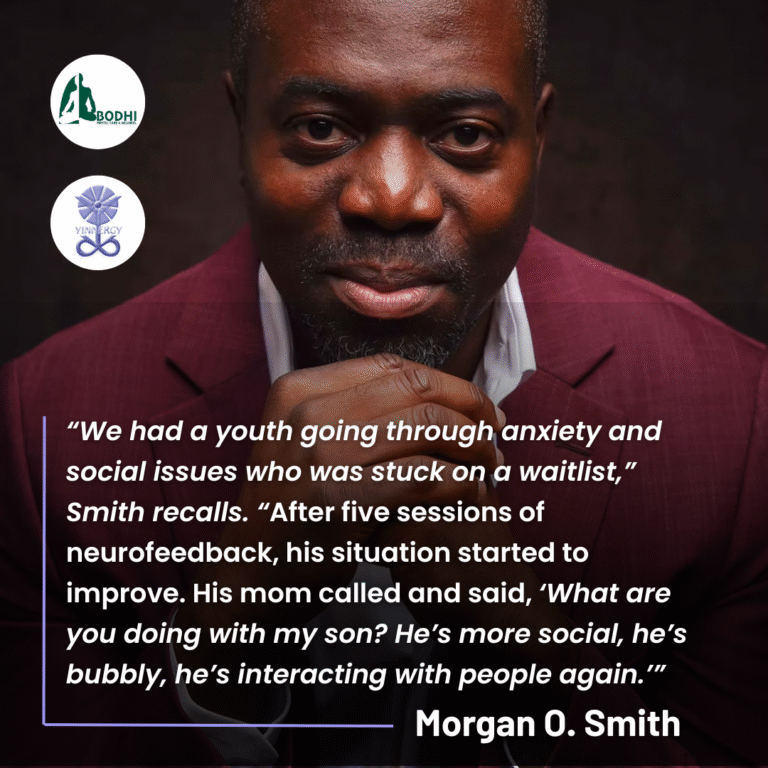
This model is already being implemented at the community level. Morgan O. Smith, founder of Yinnergy Meditation and Executive Director of Bodhi Mental Care & Wellness, has pioneered a culturally grounded neurofeedback program for youth in marginalized neighborhoods.
Smith’s program blends meditation, brainwave training and remote EEG technology provided through Divergence Neuro. His nonprofit delivers care at no cost to families, offering an example of how community-based models can supplement overstretched systems and reach clients that might otherwise disengage entirely.
Scaling Access Through Divergence Neuro
Divergence Neuro plays a critical role in scaling these kinds of culturally responsive interventions by offering clinicians, coaches, and nonprofit leaders access to remote-ready, clinician-supervised neurofeedback tools. Through our mobile app and EEG-compatible software platform, we enable professionals to deliver brain training protocols outside of traditional clinic walls, whether in schools, community centers, or home settings. This flexibility not only reduces logistical barriers like travel and waitlists but also supports engagement by meeting youth where they are. With built-in tracking, real-time session streaming, and customizable protocol options, Divergence Neuro empowers providers to deliver consistent, data-informed care that centers each client’s unique neurophysiological profile. In communities where traditional systems have failed to build trust, our approach supports a new paradigm: one that blends accessibility with accountability, and innovation with cultural humility.
Why Protocol Design Matters
Protocols used in such interventions often target alpha activity or sensorimotor rhythms, both of which have been associated with improvements in emotional resilience, impulse control, and cognitive flexibility. A 2014 meta-review by Gruzelier found significant benefits of alpha-theta training for mood regulation and creativity, while a study by Peniston and Kulkosky (1991) demonstrated long-term reductions in PTSD symptoms among veterans using similar protocols.
While neurofeedback is not a replacement for culturally competent psychotherapy, it offers a critical entry point for nervous system regulation. For clinicians working with trauma-affected youth, particularly those impacted by racial or generational stress, neurofeedback can be integrated alongside more traditional modalities to enhance outcomes.
Minority Mental Health Awareness Month should not only draw attention to inequities. It must also spotlight those who are already building viable, evidence-informed solutions. Programs like Smith’s reveal what becomes possible when access, agency, and cultural alignment are built into the design of care. As the mental health landscape evolves, it is essential that innovation is not only technological, but relational. Youth should not have to wait for care to become inclusive. They deserve models that are responsive to their realities today.
If you are exploring ways to integrate remote neurofeedback into your clinical practice or community program, we invite you to connect below.
Resources & Further Exploration
Learn more about Morgan O. Smith’s work at Website & Linktree
Explore Yinnergy Meditation:
Download the meditation program
Read ‘Bodhi in the Brain’ by Morgan O. Smith
Explore the transformative intersection of meditation and brainwave technology.
Available at: Amazon and Barnes & Noble
References
American Psychiatric Association. (2017). Mental Health Disparities: African Americans. https://www.psychiatry.org/File%20Library/Psychiatrists/Cultural-Competency/Mental-Health-Disparities/Mental-Health-Facts-for-African-Americans.pdf
Arns, M., de Ridder, S., Strehl, U., Breteler, R., & Coenen, A. (2009). Efficacy of neurofeedback treatment in ADHD: The effects on inattention, impulsivity and hyperactivity. Clinical EEG and Neuroscience, 40(3), 180–189. https://doi.org/10.1177/155005940904000311
Berger, M., & Sarnyai, Z. (2015). More than skin deep: Stress neurobiology and mental health consequences of racial discrimination. Stress, 18(1), 1–10. https://doi.org/10.3109/10253890.2014.989204
Centers for Disease Control and Prevention. (2023). Health, United States, 2023: Suicide rates and trends. U.S. Department of Health and Human Services. https://www.cdc.gov/suicide/facts/index.html
Goosby, B. J., Cheadle, J. E., & Mitchell, C. (2018). Stress-related biosocial mechanisms of discrimination and African American health inequities. Annual Review of Sociology, 44, 319–340. https://doi.org/10.1146/annurev-soc-060116-053403
Gruzelier, J. H. (2014). EEG-neurofeedback for optimising performance. I: A review of cognitive and affective outcome in healthy participants. Neuroscience & Biobehavioral Reviews, 44, 124–141. https://doi.org/10.1016/j.neubiorev.2013.09.015
Peniston, E. G., & Kulkosky, P. J. (1991). Alpha–theta brainwave neurofeedback therapy for Vietnam veterans with combat–related post–traumatic stress disorder. Medical Psychotherapy: An International Journal, 4, 47–60.
Reiter, K., Andersen, S. B., & Carlsson, J. (2016). Neurofeedback Treatment and Posttraumatic Stress Disorder: Effectiveness and Optimal Protocol Choice. The Journal of Nervous and Mental Disease, 204(2), 69–77. https://doi.org/10.1097/NMD.0000000000000418
Substance Abuse and Mental Health Services Administration. (2023). Key Substance Use and Mental Health Indicators in the United States. https://www.samhsa.gov/data/sites/default/files/reports/rpt42731/2022-nsduh-annual-national-web-110923/2022-nsduh-nnr.htm