The Cost of Silence in Minority Mental Health Care
In many racialized and marginalized communities, speaking openly about mental health remains taboo. This silence is often misinterpreted as disengagement or denial. In truth, it is frequently a learned form of protection, one rooted in generations of systemic exclusion, mistrust, and stigma. Research continues to show that communities of color in North America are less likely to access mental health care and more likely to terminate services prematurely (American Psychiatric Association, 2017). African American adults in the United States, for instance, are more likely than their white counterparts to report feelings of emotional distress, yet less likely to receive treatment (Office of Minority Health, 2023). Latinx individuals experience similar disparities, often facing linguistic and cultural barriers in accessing culturally appropriate services (Snowden et al., 2009).
Indigenous communities, particularly youth, are at elevated risk for self harm, yet encounter structural gaps in access to mental health care, especially in rural and remote areas (Leavitt et al., 2018). These disparities are not simply about availability. They also stem from how care is defined and delivered, often through frameworks that do not account for historical trauma, migration stress, or cultural norms around emotional expression.
Trauma, Culture, and the Limits of Talk-Based Care
The challenge is not merely one of access but of relevance. Traditional psychotherapeutic models often rely heavily on talk therapy and symptom-driven outcomes. While effective for some, these approaches can overlook the lived realities of clients navigating racialized stress, intergenerational trauma, or cultural norms that discourage emotional disclosure. The other significant challenge is that lived trauma often resides on a deeper neurological or even somatic layer that translates to physiological patterns which is difficult to recondition with talking alone.
For clients who struggle to articulate their experience, somatically oriented modalities offer a different kind of entry point. Biofeedback and neurofeedback therapies allow the body to speak when words fall short. In the case of trauma, protocols that target alpha-theta crossover states have been shown to support emotional processing through deep relaxation and lowered cortical arousal (Peniston & Kulkosky, 1991). More recent studies have explored protocols using sensorimotor rhythm (SMR) training to improve sleep, focus, and affect regulation in clients with PTSD symptoms (Reiter et al., 2016).
Rather than requiring clients to describe their feelings, these protocols create space for clients to regulate them safely, incrementally, and often without needing to verbalize.
Designing Treatments That Reflect Lived Experience
To be effective, mental health care must align with the individuality of those it serves. That includes understanding how marginalization shapes the body’s stress response. Studies have shown that chronic exposure to racism can elevate the body’s overall stress level, disrupting the autonomic nervous system and increasing vulnerability to anxiety, hypertension, and depression (Berger & Sarnyai, 2015). Interventions that train clients to monitor and influence physiological signals, such as heart rate variability (HRV), respiration, or EEG patterns can support recovery from the embodied effects of trauma.
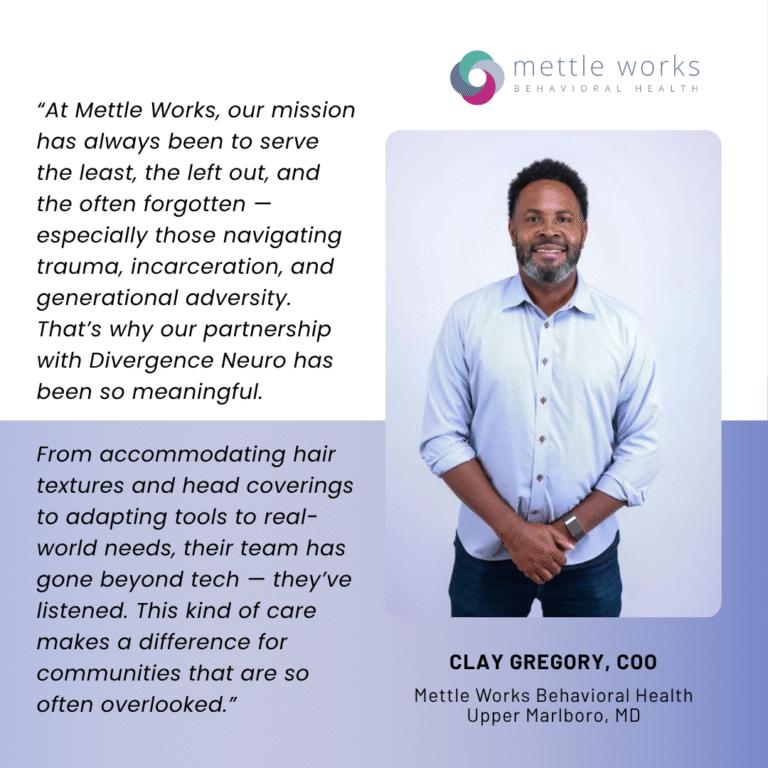
As Clay Gregory, Chief Operating Officer of Mettle Works Behavioral Health, reflects, partnerships rooted in cultural responsiveness and practical flexibility can be as essential as the technology itself.
For example, neurofeedback protocols aimed at enhancing alpha activity have been associated with improvements in emotional resilience and cognitive flexibility, both of which are impacted by chronic stress exposure (Gruzelier, 2014). In clients with culturally bound expressions of distress through physical symptoms or bottling of emotions, these techniques may offer greater insight and relief where language falls short.
More importantly, culturally attuned clinicians are increasingly customizing these protocols based on individual client needs. This may involve adjusting thresholds, prioritizing sensor placement that reflects the client’s presenting issues, or integrating breathwork and mindfulness practices to reinforce autonomous nervous system resilience. No protocol is universally effective. Flexibility, feedback, and collaboration remain essential in a relational therapeutic approach.
Redefining What Healing Looks Like
Mental health success is often defined narrowly, as symptom reduction or diagnostic remission. But for many clients from marginalized groups, healing may take a different form. It might mean reestablishing safety in the body. It might mean reconnecting to ancestral identity, or naming grief that was inherited but never acknowledged.
A culturally responsive, evidence-based practice makes room for these broader definitions. It acknowledges that verbal fluency is not the only sign of engagement, and that regulation is as vital as insight. Biofeedback and neurofeedback are not replacements for talk therapy, but they expand the tools that therapy can leverage.
As clinicians explore new tools and protocols to support mental health equity, the goal should not only be to standardize outcomes. It should also be to deepen the individual’s relationship with themselves and those around them through data, through culture, and through presence.
Let’s Create More Inclusive and Effective Mental Health Care
Interested in using neurofeedback to better support your clients? Fill out the form below to get in touch and explore how our tools can help.
References
American Psychiatric Association. (2017). Mental Health Disparities: African Americans. https://www.psychiatry.org/File%20Library/Psychiatrists/Cultural-Competency/Mental-Health-Disparities/Mental-Health-Facts-for-African-Americans.pdf
Berger, M., & Sarnyai, Z. (2015). More than skin deep: Stress neurobiology and mental health consequences of racial discrimination. Stress, 18(1), 1–10. https://doi.org/10.3109/10253890.2014.989204
Gruzelier, J. H. (2014). EEG-neurofeedback for optimising performance. I: A review of cognitive and affective outcome in healthy participants. Neuroscience & Biobehavioral Reviews, 44, 124–141. https://doi.org/10.1016/j.neubiorev.2013.09.015
Leavitt, P. A., Covarrubias, R., Perez, Y. A., & Fryberg, S. A. (2015). “Frozen in time”: The impact of Native American media representations on identity and self – understanding. Journal of Social Issues, 71(1), 39–53. https://doi.org/10.1111/josi.12095
Office of Minority Health. (2023). Mental and behavioral health: African Americans. U.S. Department of Health and Human Services. https://minorityhealth.hhs.gov/
Peniston, E. G., & Kulkosky, P. J. (1991). Alpha–theta brainwave neurofeedback therapy for Vietnam veterans with combat–related post–traumatic stress disorder. Medical Psychotherapy: An International Journal, 4, 47–60.
Reiter, K., Andersen, S. B., & Carlsson, J. (2016). Neurofeedback Treatment and Posttraumatic Stress Disorder: Effectiveness and Optimal Protocol Choice. The Journal of Nervous and Mental Disease, 204(2), 69–77. https://doi.org/10.1097/NMD.0000000000000418
Snowden, L. R., Masland, M. C., Fawley, K., & Wallace, N. (2009). Ethnic Differences in Children’s Entry into Public Mental Health Care via Emergency Mental Health Services. Journal of child and family studies, 18(5), 512–519. https://doi.org/10.1007/s10826-008-9253-7