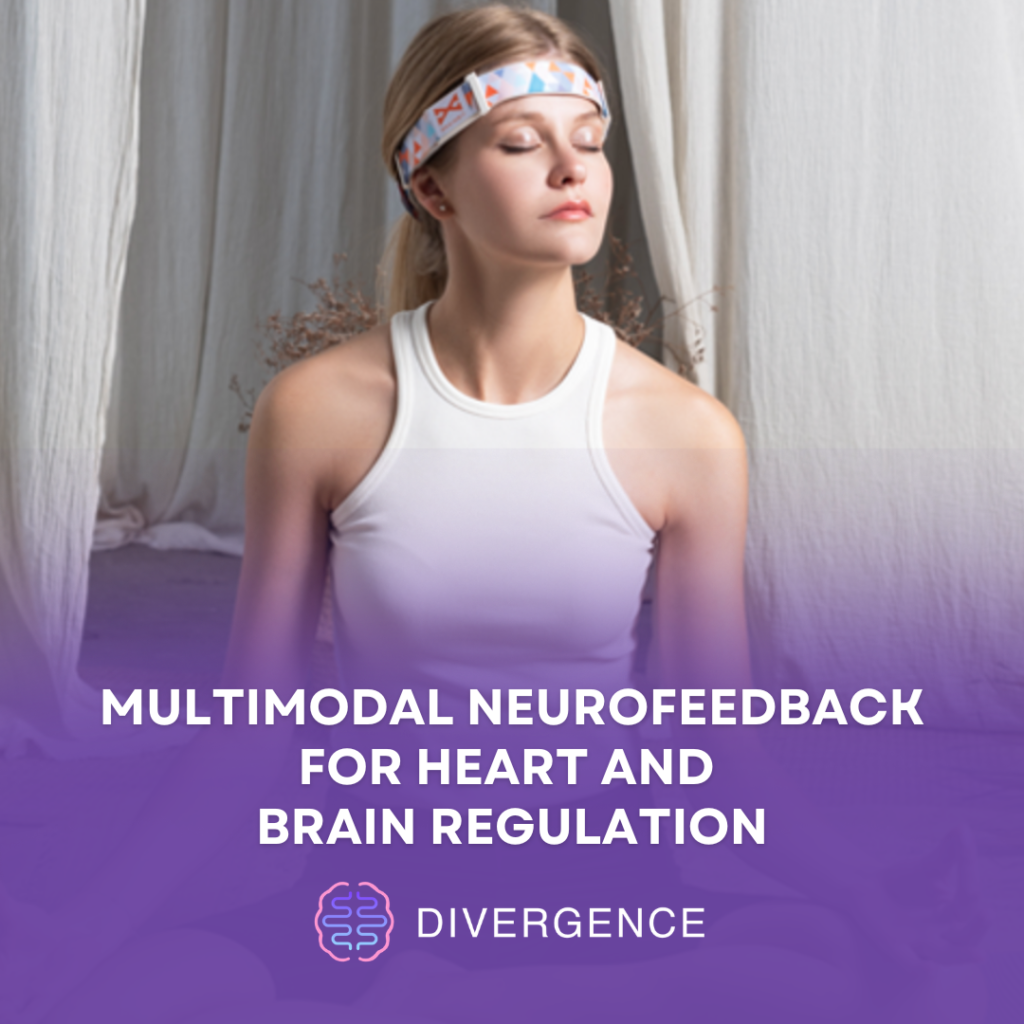
Understanding the dynamic interplay between the heart and brain is increasingly important for clinicians using neurofeedback and biofeedback. Research demonstrates that simultaneous monitoring of neural and cardiac activity provides actionable insights into self-regulation, autonomic balance, and functional neurological connectivity. By leveraging multimodal approaches that combine EEG with ECG-based measures of heart rate variability (HRV), clinicians can gain a more comprehensive understanding of a client’s regulatory capacity and identify patterns that may not be observable using EEG alone (Schumann et al., 2021; Lee et al., 2022). In practical clinical settings, technologies that simplify these measurements such as wireless, dry EEG and ECG systems enable clinicians to capture high-fidelity physiological data without gels, pastes, or complex setup, making it easier to integrate heart-brain co-regulation assessment into routine practice.
Heart and Brain Interaction in Clinical Contexts
The coupling between cardiac and neural signals reflects a networked interaction among cognitive, emotional, and autonomic systems. Research suggests that HRV is closely associated with prefrontal cortex regulation, attention control, and emotional resilience. Integrating EEG with ECG provides clinicians with insight into both neural activity and autonomic function simultaneously, enabling protocols that target brain-heart feedback loops more effectively (Catrambone et al., 2024). Modern neurofeedback devices support these measurements with portable, wireless, and dry sensor systems, allowing for fast, mess-free session initiation. Clinicians can place EEG sensors flexibly on the scalp and ECG sensors on the chest without compromising signal quality, streamlining workflow and improving client compliance, whether sessions are conducted in-person or remotely.
Heart Rate Variability Biofeedback and Functional Brain Connectivity
Heart rate variability biofeedback (HRV-BF) is increasingly recognized for its ability to influence functional brain connectivity. Studies show that structured HRV training enhances communication between prefrontal and limbic regions, improving emotion regulation, cognitive flexibility, and stress resilience (Schumann et al., 2021). Clinicians integrating HRV biofeedback with EEG-based neurofeedback can target both neural and autonomic systems concurrently, creating synergistic effects. Wireless and dry EEG/ECG devices facilitate this integration by providing high-quality, low-noise signals, making complex, multimodal protocols feasible without the logistical challenges of traditional gel-based systems. As neurofeedback evolves, incorporating adjunctive technologies such as photobiomodulation (PBM) has shown potential to enhance cortical excitability and neuroplasticity, further supporting cognitive and emotional outcomes when used alongside biofeedback interventions. PBM may be particularly relevant in protocols targeting attention, memory, or mood, though clinicians should rely on evidence-based guidance for dosing and parameters.
Mechanistic Insights into Brain-Heart Feedback Loops
Emerging studies on heartbeat-evoked potentials (HEPs) provide insight into the mechanistic pathways linking cardiac activity and cortical processing (Cortese et al., 2022). These feedback loops suggest that autonomic activity directly informs neural function, providing a physiological rationale for interventions that integrate EEG and HRV. Clinicians can leverage this knowledge to design tailored protocols that support self-regulation and resilience. Wireless, dry EEG and ECG systems enhance these approaches by allowing real-time acquisition of high-fidelity data from both brain and heart, enabling precise feedback delivery without the setup delays, client discomfort, or preparation errors that often accompany traditional neurofeedback hardware.
Clinical Implications for Neurofeedback Practitioners
For clinicians, these insights and technologies translate into practical advantages. Combining EEG and ECG monitoring provides a more complete picture of client physiology, enabling informed decisions about protocol design, session progression, and expected outcomes. Clinicians using Divergence Neuro’s systems with Synchroni devices can leverage high-fidelity EEG and ECG data in a wireless, dry format, supporting both neurofeedback and biofeedback interventions with minimal setup and maximum client comfort. Heart-brain co-regulation protocols may be further enhanced through adjunctive approaches such as photobiomodulation, which can be applied to targeted cortical regions to facilitate neuroplasticity in combination with feedback training. Using wireless, dry systems ensures that multimodal measurements are easy, mess-free, and repeatable, whether training complex neural networks, completing structured assessments, or delivering remote sessions. By integrating these evidence-informed strategies, clinicians can improve client engagement, monitor subtle physiological changes, and optimize the therapeutic impact of neurofeedback interventions.
Keep Up with Advances in Neurofeedback and Biofeedback
The Divergence Neuro newsletter delivers evidence-based insights, updates on platform innovations, and practical perspectives from clinicians applying neurofeedback and biofeedback in both in-person and remote settings.
Sign up to receive the latest research updates, platform advancements, and real-world clinical insights directly in your inbox.
References
Catrambone, V., Candia‑Rivera, D., & Valenza, G. (2024). Intracortical brain‑heart interplay: An EEG model source study of sympathovagal changes. Human Brain Mapping. https://pmc.ncbi.nlm.nih.gov/articles/PMC11041380
Cortese, M. D., Vatrano, M., Tonin, P., et al. (2022). Inhibitory control and brain‑heart interaction: An HRV‑EEG study. Brain Sciences, 12(6), 740. https://pmc.ncbi.nlm.nih.gov/articles/PMC9221218
Lee, D., Kwon, W., Heo, J., & Park, J. Y. (2022). Associations between heart rate variability and brain activity during a working memory task: A preliminary electroencephalogram study on depression and anxiety disorder. Brain Sciences, 12(2), 172. https://www.mdpi.com/2076-3425/12/2/172
Schumann, A., de la Cruz, F., Köhler, S., Brotte, L., & Bär, K.-J. (2021). The influence of heart rate variability biofeedback on cardiac regulation and functional brain connectivity. Frontiers in Neuroscience, 15, 691988. https://www.frontiersin.org/articles/10.3389/fnins.2021.691988/full