Three research-grounded ways to train calmer, steadier, more focused states, now available to every practitioner on the Divergence platform.
Stress rarely announces itself. It shows up as a shorter fuse, a scattered afternoon, a night of shallow sleep. What most people never see is that it also shows up in the rhythm of their heart, and that this rhythm can be trained.
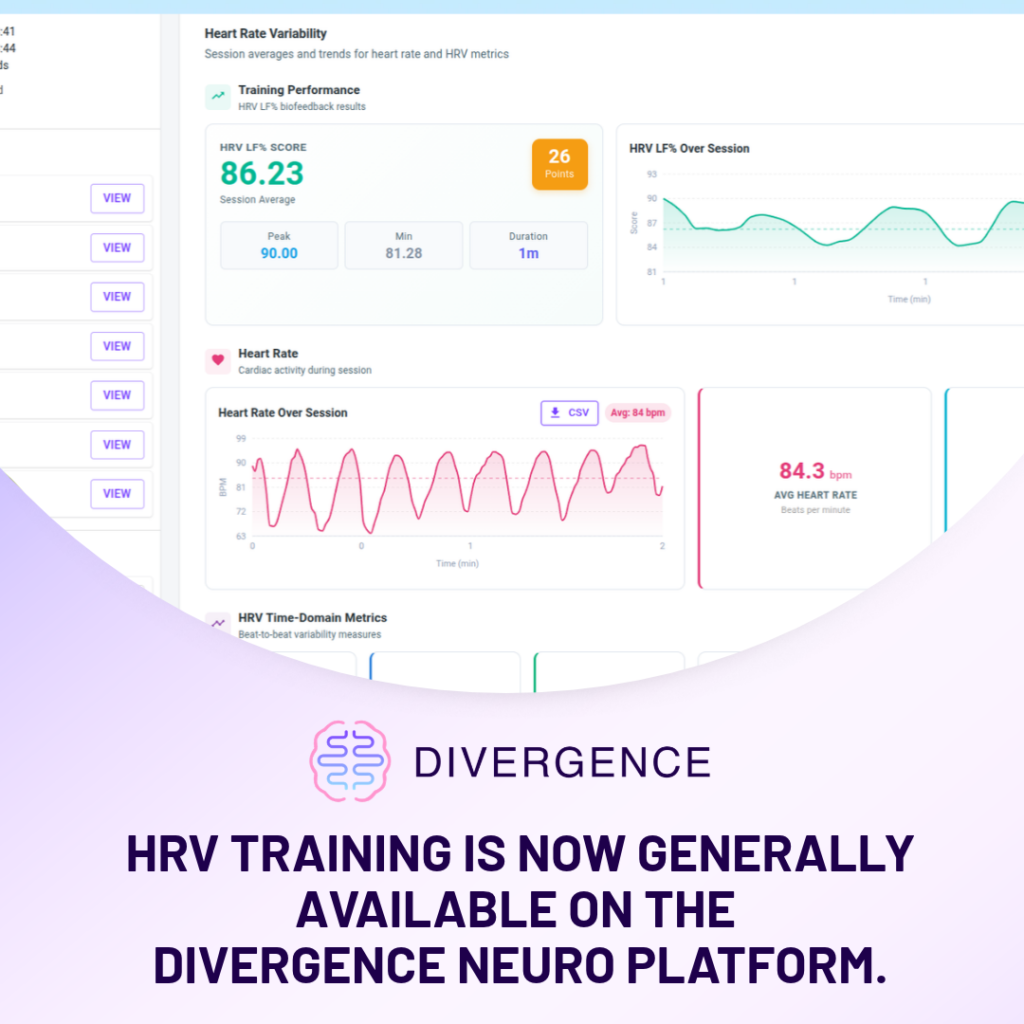
Today we’re making HRV Training generally available on Divergence. It turns a few minutes of slow, guided breathing into real-time feedback from the heart, so clients learn what a calm, regulated state actually feels like and how to get back to it on demand.
Why train the heart?
Your heart doesn’t beat like a metronome. The small shifts in timing between beats, known as heart rate variability (HRV), reflect how flexibly your nervous system is adjusting to what’s happening around you (Shaffer & Ginsberg, 2017). Breathe slowly and evenly, and that variability rolls into a smooth, rising-and-falling wave. HRV biofeedback shows people that wave as it happens, so they can learn to create it.
The research behind this is substantial:
- Less stress. A meta-analysis of 24 studies found HRV biofeedback training was associated with a large reduction in self-reported stress and anxiety (Goessl et al., 2017).
- Sharper focus. A systematic review of 16 studies found that most reported gains in at least one executive function, with attention benefiting most often (Tinello et al., 2022). This fits a broader line of work linking higher HRV to better prefrontal, self-regulatory performance (Thayer et al., 2009).
- Better performance under pressure. Across 58 randomized controlled studies, HRV biofeedback showed a significant effect, with some of the largest effects on anxiety, anger and athletic or artistic performance (Lehrer et al., 2020). Athletes in particular have used it to improve sport performance (Jiménez Morgan & Molina Mora, 2017).
- Calm and alert at the same time. Slow breathing is associated with greater relaxation and comfort alongside increased vigor and alertness (Zaccaro et al., 2018).
The common thread is resonance. Most people have a breathing rate, usually near six breaths a minute, where heart rhythm, blood pressure and breath fall into step and reinforce each other (Lehrer & Gevirtz, 2014). Finding and holding that rate is a trainable skill, and it’s what HRV Training is built to teach.
Three modes, one path to mastery
HRV Training ships with three feedback modes. Each scores the same heart signal a different way, so practitioners can match the training to the person in front of them.
| Mode | What it Rewards | Best For |
|---|---|---|
| RSA | A smooth, wave-like rhythm right now; responds in about 10 seconds | First sessions, kids and teens, quick resets between meetings |
| LF (Low Frequency) | How much variability sits in the slow regulation band; a 60-second view | Tracking progress week over week, clinical and research settings |
| Coherence | The whole rhythm locking into one clean wave; a 60-second view | Resonance breathing work and returning users ready for depth |
We designed them to work as a progression: RSA to hook, LF to retain, Coherence to master. A newcomer sees the screen respond within their first two breaths. A regular user gets numbers that still mean something next week. An experienced user gets a skill with a real ceiling.
Whichever mode drives the feedback, every session records the full standard HRV panel, including RMSSD, SDNN, LF, HF and average heart rate. Nobody has to choose between the mode they enjoy and the data their practitioner needs.
Built for how practitioners work
- Clinicians and wellness practitioners can add a few minutes of HRV Training alongside neurofeedback, giving clients a self-regulation skill they can use between sessions.
- Performance coaches can build pre-game or pre-performance routines around a state athletes learn to reach on cue.
- Enterprise and workplace programs get a short, repeatable stress reset with a trend line that shows whether the habit is working.
It runs on the hardware you already use: an ECG chest strap or an optical pulse sensor, with contact quality tracked continuously so a loose sensor never quietly becomes a bad score. Modes can also be combined within a single protocol, pairing fast, moment-to-moment guidance with a slower session verdict.
Get Started
HRV Training is available now on the Divergence platform. Start new clients on RSA for a fast, encouraging first session, then move them toward Coherence as the skill builds.
Want to more about the new HRV Training features? Book a demo with us today!
HRV Training is a skills-training tool for self-regulation. It is not intended to diagnose, treat, cure or prevent any medical condition. The research cited here describes HRV biofeedback and resonance breathing in general, not Divergence’s specific scoring algorithms.